Entryway & Hallway
Narrow Hallway Decorating Ideas That Keep the Walkway Clear
Explore 12 narrow hallway decorating ideas with runners, art, mirrors, lighting and renter-friendly touches that add style without blocking the walkway.
- Published
- November 23, 2026
- Reading time
- 17 minutes
- By
- NorahDecor Editorial
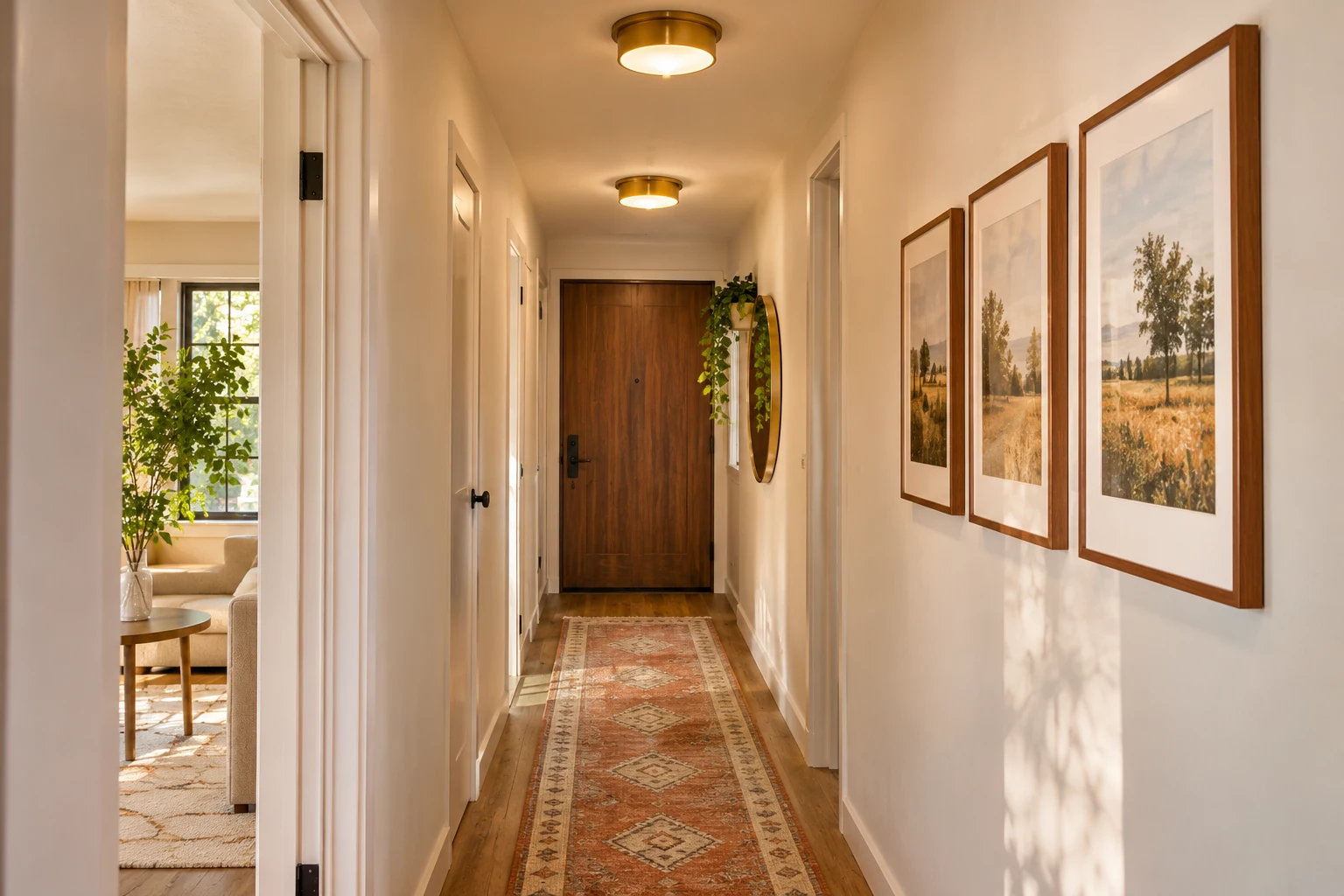
A narrow hallway is easy to overlook because it isn't a room where anyone spends much time. But it is often the first view of a home, the route between busy rooms, and the place where bad decorating decisions become obvious. A rug catches under a door. Picture frames stick out at shoulder height. A console looks charming in a photograph but leaves almost no room to carry a laundry basket past it.
The most useful narrow hallway decorating ideas work with the space instead of asking it to behave like a living room. You can make a corridor feel warmer with lighting, art, color, and texture without filling it with furniture. The trick is to identify the surfaces that can carry the design: usually the floor, the walls, and sometimes the end of the hallway.
These twelve ideas focus on long, skinny corridors in apartments and ordinary homes. They include renter-friendly options, practical layout checks, and a few decorating changes that cost little more than time and planning.
First, measure the hallway as a passage, not a room
Before shopping, walk from one end to the other while carrying something awkward, such as a laundry basket or a folded drying rack. Open each nearby door and notice where it swings. Then measure the hallway at its narrowest point, not just at the widest section.
Make a quick note of five things:
- Clear route: How much usable walking space remains once trim, doors, radiators, and existing furniture are accounted for?
- Door swings: Which closet, bathroom, bedroom, or exterior doors open into the corridor?
- Wall opportunities: Are there continuous stretches suitable for art, a mirror, or an extremely shallow display?
- Light: Is the middle of the hallway darker than its ends, and is there enough light to use it safely at night?
- Practical constraints: Are there vents, switches, heating equipment, handrails, access panels, or escape routes that must remain unobstructed?
There is no single decorative furniture depth that works in every hallway. Requirements for egress and accessible routes depend on the building and local rules. If a new piece compromises the usable route, leave it out. The U.S. Fire Administration advises keeping exits and escape paths clear as part of home fire planning. See the USFA home fire escape guidance.
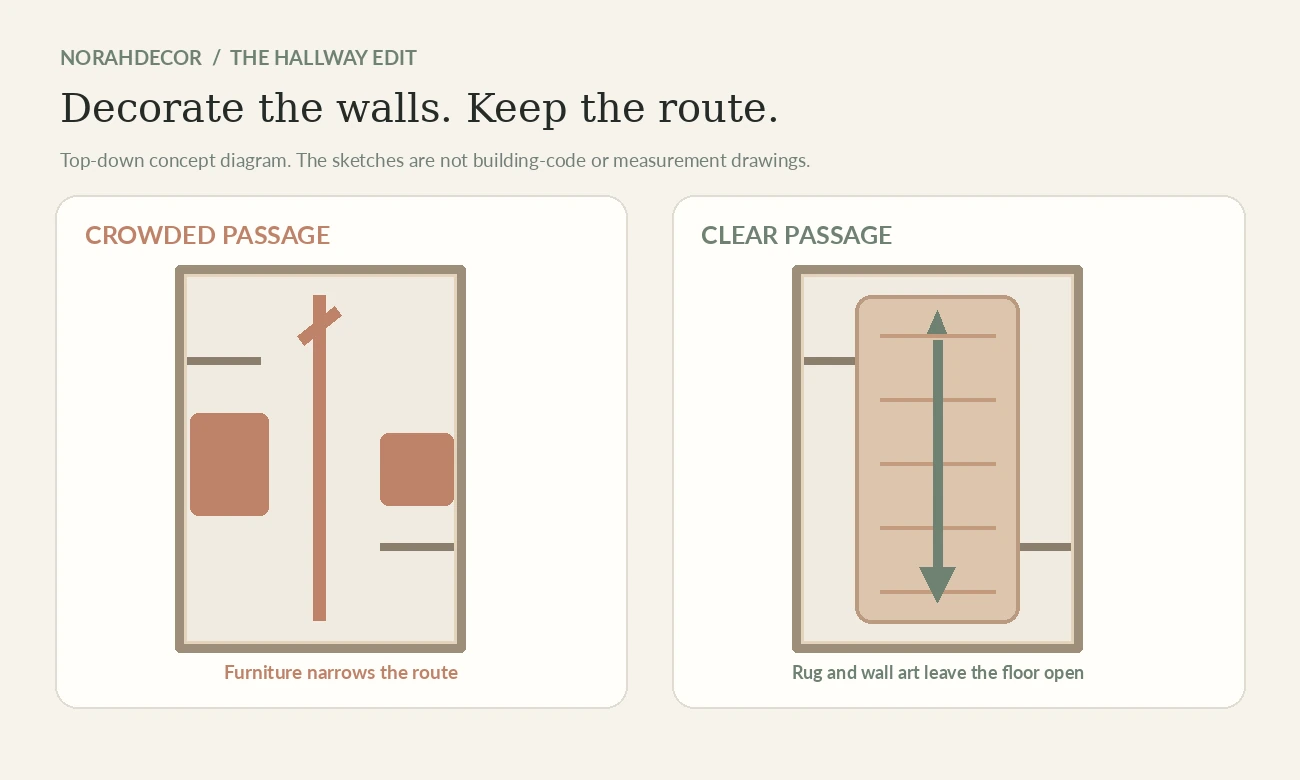
Choose a strategy for the hallway you actually have
| Your hallway situation | Best starting moves | Usually skip | | --- | --- | --- | | Very narrow, with doors on both sides | Better lighting, wall color, flat art, a well-fitted runner | Freestanding tables, floor baskets, projecting hooks | | Long corridor with no daylight | Evenly distributed light, a thoughtful end-wall focal point, reflective surfaces | One harsh light at the far end | | Wide enough for some wall display | Small gallery arrangement, properly mounted mirror, carefully measured ledge | Oversized frames or a bulky console | | Rental with no drilling allowed | Runner with suitable grip, wall-safe removable art where permitted, coordinated paint-free textiles | Unapproved hardware, untested adhesive on fragile finishes | | Hallway that connects multiple rooms | Repeated framing, consistent trim, a limited color palette | A different decor theme at every doorway |
1. Start with a runner that leaves the doors working
A runner is one of the few decorating pieces that can make a long hallway feel finished without requiring an extra shelf or cabinet. Pattern, color, and texture draw the eye through the corridor, and a well-chosen rug can soften noise on hard flooring.
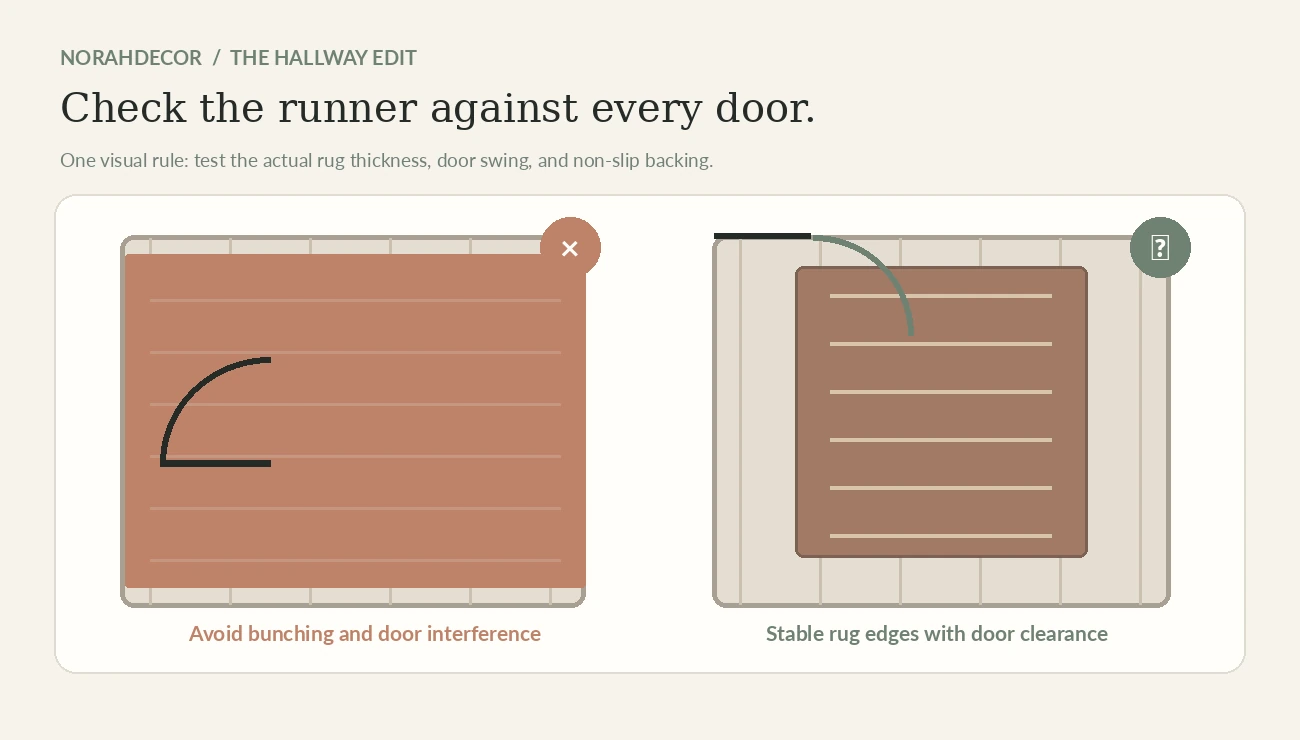
Before buying, measure the clear floor width and the distance between door swings. Check the thickness of the rug and its pad against every door that opens over it. A beautiful runner that bunches up beneath a bathroom door is the wrong runner. If the corridor is irregular, a shorter rug that ends before the difficult doorway may work better than trying to cover the entire length.
For a busy hallway, look for an easy-to-clean, relatively low-profile weave. A flatwoven patterned runner can hide everyday marks better than a very pale, plush rug. Use a gripping underlay suited to the rug and flooring, following the manufacturer's instructions. IKEA specifically recommends anti-slip underlay for high-traffic rug locations such as hallways in its rug guidance.
Best for: Straight hallways with exposed floor and door clearance. Skip it if: Even a thin rug creates a trip edge or catches a door.
2. Make a gallery wall that reads as one composition
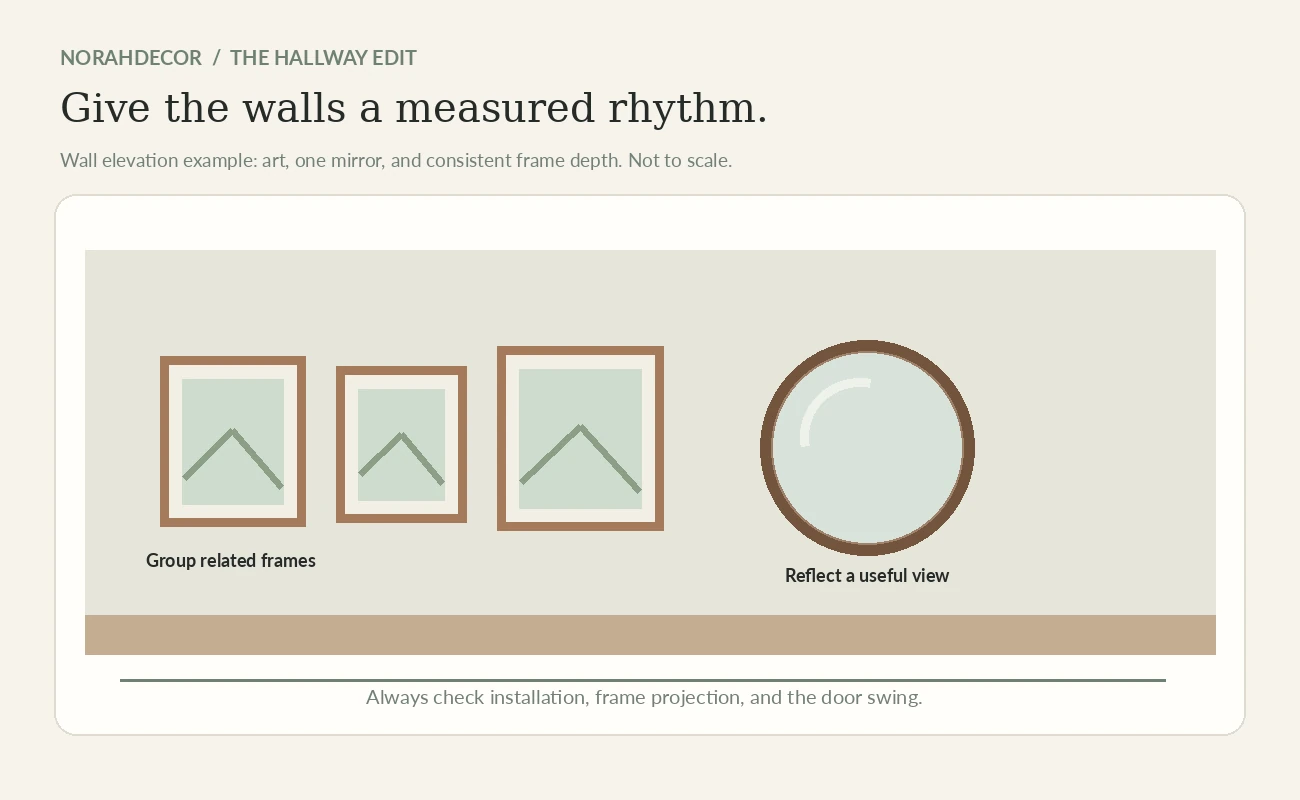
A row of photographs or drawings can turn a blank corridor into something personal without taking floor space. The common mistake is treating each empty patch of wall as a separate opportunity. Ten unrelated frames at different heights can make an already busy hallway feel even busier.
Instead, choose a clear rule. You might use matching wood frames in two sizes, a narrow line of black-and-white photography, or several pieces sharing a similar background tone. Arrange the grouping on the floor first, or make paper templates and tape them to the wall so you can stand at both ends and see the composition.
Watch the depth: A heavily framed artwork can protrude farther than you expect. Slim frames generally work better in a tight passage than deep box frames. Mount everything securely according to its weight and the wall construction. If the passage includes a door that swings against this wall, test the full swing before choosing a frame location.
For more detailed arrangement help, our gallery wall ideas for living rooms article explains planning with templates and building a balanced mix of frames. The same approach can be adapted to a corridor, using fewer pieces and shallower frames.
3. Let a mirror reflect something worth seeing
A mirror can carry daylight from a nearby room or make a dull end wall feel more interesting. But hanging the largest mirror you can find is not always the answer. A mirror facing a messy closet or reflecting a harsh ceiling light can amplify exactly the view you wanted to soften.
Walk along the corridor and look at the spot from different angles. A mirror across from a doorway might reflect a plant or daylight from another room. At the end of a hall, it can create a focal point without adding furniture. A tall, simple shape can also balance the proportions of a long, low corridor.
Choose mounting hardware appropriate for the mirror's weight and the wall. Heavy mirrors should not be treated as casual peel-and-stick decor. If you rent, consider a small lightweight mirror only where its installation method and surface are approved. Never place a freestanding leaning mirror where it can be knocked into the walking path.
Small-space takeaway: A carefully placed medium mirror is often better than a huge one in an awkward position.
4. Light the middle of the hallway, not only its ends
A corridor with a sunny room at each end can still feel gloomy in the middle. If the hallway has ceiling fixtures, look at whether the light is evenly distributed along the whole route. One central ceiling light may be enough in a short hall but leave a long one with dark patches.
Choose compatible bulbs and fixtures that provide comfortable illumination without glare. Low-profile ceiling lights can be particularly useful where there is limited headroom. Wall lights can add character when the hall is wide enough, but their projection must not interfere with people carrying bags or with required clearance. Recessed or close-to-wall fixtures are often easier to live with than decorative arms that stick into the corridor.
If lighting needs new wiring, an electrician should assess the installation. For a rental or a low-budget refresh, start with cleaning existing shades, replacing bulbs only within fixture specifications, and using light from adjacent rooms where possible. Do not run extension cords or plug-in light cables across the hallway floor.
For visual warmth, a consistent light appearance usually works better than mixing very cool and very warm bulbs along one short sightline. Check the result after sunset, when the hallway is actually most dependent on artificial light.
5. Use paint to create continuity between doors
Hallways often include more doors, trim, and interruptions than ordinary rooms. A thoughtful paint scheme can help those pieces feel like one composition. Try repeating the same trim finish on all door frames, or use a slightly different wall color while keeping the doors consistent.
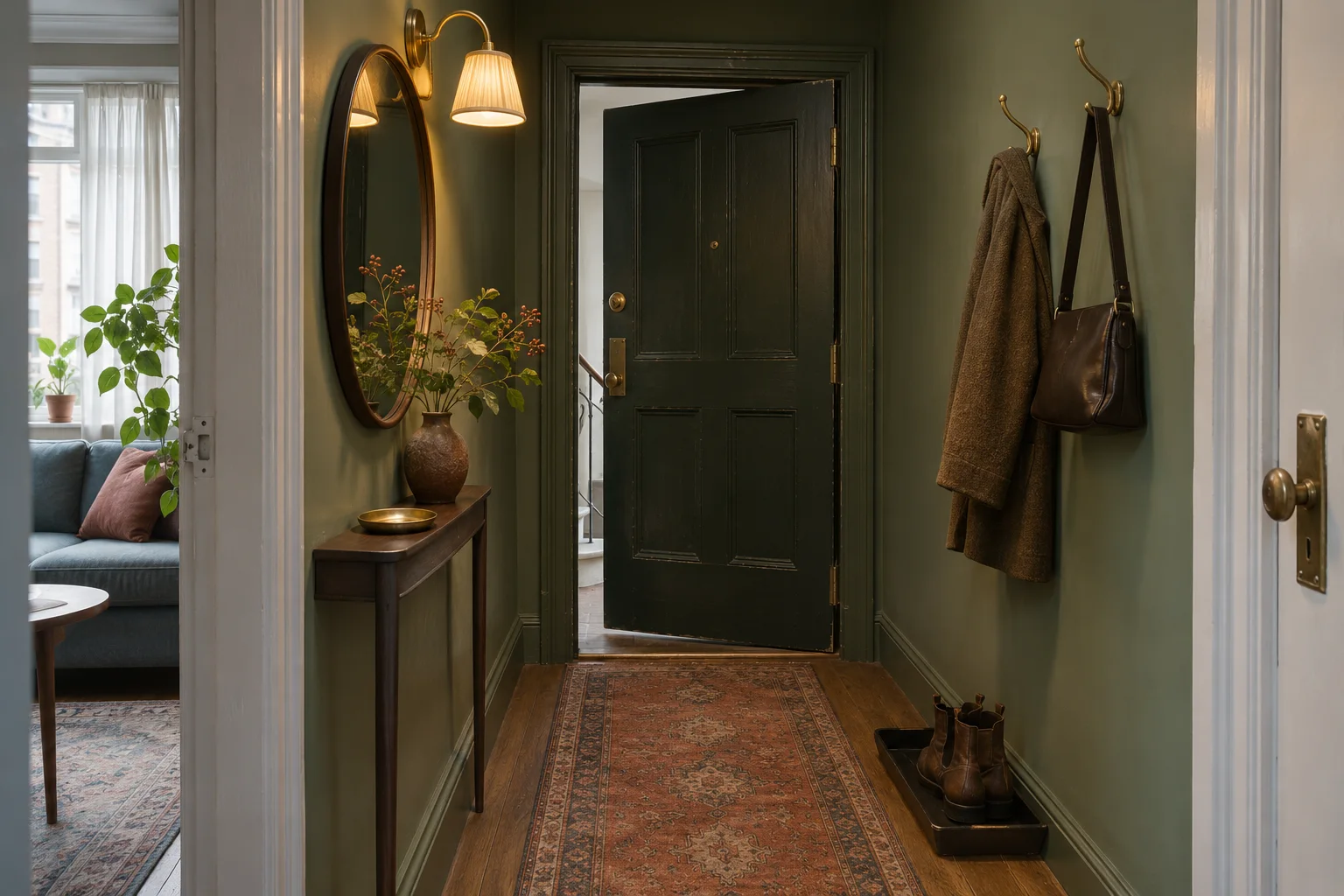
Light colors can be useful in dim corridors because they work with the available lighting, but they do not magically create more square footage. A deeper color can work beautifully if the lighting is good and the rest of the home supports it. The important choice is coherence rather than a rule that narrow spaces must always be white.
Test samples at several points along the hallway. A color near a bright doorway may look quite different in a dim corner. If the corridor has many doors, painting the doors and trim the same or closely related color can reduce visual interruption. For a renter who cannot paint, repeat the color through frames and the rug instead.
Best for: Hallways where mismatched doors or wall patches make the space feel fragmented.
6. Try one wallpaper moment instead of four competing patterns
Wallpaper can give a corridor real personality because there is less furniture competing with it. But an all-over busy pattern may exaggerate the narrowness if the hall already has many doorways, frames, and switches.
A restrained approach is to wallpaper the end wall, a recessed section, or one uninterrupted stretch of wall. Small-scale botanical patterns, subtle stripes, and textured prints can work; larger patterns can be effective too if there is enough continuous wall to appreciate them. The correct scale depends on the actual view, not a blanket design rule.
Renters should check permission and product specifications carefully. Removable wallpaper can still damage fragile paint or surfaces, particularly in damp or poorly prepared areas. Obtain a sample and test where allowed. Keep wallpaper away from heat sources or fixtures unless its product instructions allow the application.
A useful test is to take a phone photograph from the place where you normally first see the hall. If the pattern is the only thing your eye notices, decide whether that is the effect you genuinely want.
7. Give the end of the hallway a deliberate focal point
Many long hallways end in a blank wall, a closed door, or a view into another room. That ending matters because the eye naturally travels along the corridor. Rather than installing small decorative objects the entire length, create one considered stopping point.
An artwork at the far end can introduce color. A narrow wall mirror can reflect light. A richly painted door may be the simplest solution of all. If there is a natural recess that stays outside the walking route, a plant on an existing window ledge may be enough.
Keep the end-wall piece in proportion to the available wall, with switches and doors still accessible. Don't place a plant stand or basket directly in front of a door just to create the photograph you saw online.
Try this first: Remove everything movable from the hall, then temporarily hold a framed picture at the end wall. If the corridor suddenly feels more intentional, you may not need any furniture at all.
8. Use a picture ledge only where there is genuine clearance
A shallow ledge can make it easy to change seasonal art, lean small frames, or display a favorite postcard. It is not suitable for every narrow hallway, and the word shallow is relative to the space.
Measure the projection from the wall, including any frames that will lean against it. Check the narrowest passage with doors open and imagine someone walking through with a large bag. Install a ledge only if the resulting route is comfortable, allowed, and compliant with relevant requirements. Position it so objects cannot easily be brushed off by a passing shoulder.
Use proper wall fixings for the shelf and its load; do not exceed the manufacturer's ratings. For an especially skinny corridor, skip the ledge and hang art flat on the wall instead. The absence of furniture isn't a decorating failure.
9. Make doorways feel like part of the design
A corridor with four or five doors can feel visually chopped up. Before buying more decor, look at the repeated elements already there: door handles, trim, hinges, and wall switches.
You may be able to create a cleaner look simply by matching existing hardware finishes where replacement is appropriate, cleaning stained switchplates, or repainting trim with permission. If your budget is small, start with the door that is directly visible from the hallway entrance. That single view often contributes more to the impression of the space than a decorative basket.
Do not alter fire-rated doors, door closers, latches, locks, or accessibility hardware without approval and appropriate professional advice. On rentals, ask before swapping fixtures. A hallway should be easy to navigate and use first, and visually coordinated second.
10. Work with a recessed spot rather than the walking lane
An awkward recess beside a bedroom door or under a stair can sometimes support a tiny design moment. A small plant on an existing built-in ledge, a portrait in a niche, or a wall-mounted key hook in a genuine alcove may be enough.
The key is to keep the decoration inside the recess, not projecting into the main path. Measure the opening and think about what people carry through it. A decorative stool that looks harmless when the hallway is empty might become a nuisance when someone is moving a vacuum cleaner or a suitcase.
Tall furniture introduced into a niche must still be appropriate for the location and securely anchored where necessary. The U.S. Consumer Product Safety Commission advises anchoring bookcases, dressers, and similar furniture to prevent tip-overs; this is especially important when children may be present. See CPSC's Anchor It guidance.
If the recess is too small for anything useful, letting it remain open can make the hallway calmer.
11. Repeat one material to connect the corridor to nearby rooms
An easy way to keep the hallway from looking like an unrelated decorating project is to borrow one material already used in the home. If the living room has walnut furniture, choose a walnut-toned frame. If the adjoining rooms feature brass, echo it in a mirror frame or an existing ceiling fixture. If your rug has muted rust, carry a little of that shade into a photograph mat or artwork.
This does not mean everything must match. The point is to give the eye a connection from the corridor to the rooms beyond it.
A useful exercise is to collect three samples: one floor or rug color, one frame or metal finish, and one wall color. If you are tempted to add five more accents, try the original three first. In a narrow hall, a restrained material palette can feel more intentional than lots of small accessories.
For a broader decorating approach, see our small apartment decor ideas guide, which looks at how adjacent zones can relate without using identical furniture.
12. Change the mood seasonally without adding obstacles
A hallway can reflect the season without becoming another area that needs storage. Instead of adding a floor tree, extra baskets, or a large wreath projecting from a door, swap the art in an existing frame, change the runner if you already own an appropriate alternative, or add a small seasonal accent in a safe recessed location.
For autumn, a rust-and-olive print may be enough. For winter, try a simple botanical illustration or a small garland attached to a suitable flat surface using a product approved for that material and load. Keep it away from door hardware, heating equipment, and anything that needs to open.
If using adhesive products, follow the specific product's weight, surface, curing, and removal instructions. Command's guidance notes restrictions for wallpaper and some other finishes, and not every hook or strip is intended for framed artwork. See the manufacturer's picture-hanging guidance.
The advantage of a seasonal swap is that the hallway keeps working in exactly the same way after the decoration goes up.
A 30-minute hallway decorating plan
If you want to improve the corridor without buying anything yet, do this in order:
- Five minutes: Clear the walking route and open every door. Put anything that has migrated into the hall back where it belongs.
- Five minutes: Measure the narrowest width, door swings, and any possible rug length. Photograph the corridor from both ends.
- Five minutes: Notice the lighting at the darkest point and decide whether it needs a practical improvement.
- Five minutes: Move one existing framed picture or mirror into a potential position. Check the view from both ends.
- Ten minutes: Choose one main treatment, such as a runner or a gallery row, and one supporting detail, such as coordinated frames or a paint sample.
Don't buy every item on the same day. A hallway often looks more resolved after one strong choice than after several weak ones.
Four hallway decorating mistakes to avoid
Buying furniture because a photo shows it
A narrow console can look wonderful in a staged image and be annoying in everyday use. Decide whether the remaining corridor works for people and objects that actually pass through it before introducing furniture.
Ignoring the doors
A long runner, stool, or open shelf that interferes with a door will never feel like an upgrade. Work around the full opening arc, not just the closed-door photograph.
Hanging decor too far into the walkway
Deep picture frames, projecting sconces, loose hooks, and poorly secured mirrors can become obstacles. Check mounting methods, projection, and applicable requirements.
Trying to solve darkness with color alone
Paint can change the mood but cannot replace adequate lighting. If a hall is dim or difficult to use safely, improve usable illumination before choosing a sophisticated paint shade.
Frequently asked questions
How do you decorate a very narrow hallway without furniture?
Focus on surfaces that do not occupy the floor: wall art, a suitable mirror, consistent paint or trim, and better lighting. A low-profile runner can introduce warmth if it stays flat, grips safely, and clears all doors. You don't need a console for a hallway to feel finished.
Should a narrow hallway be painted white?
Not necessarily. A light tone may be helpful in some darker spaces, but warmer neutrals, muted colors, and even deeper shades can work with the right lighting and neighboring rooms. Test the paint in the actual corridor at different times before committing.
What size runner should I use in a narrow hallway?
Measure the clear floor width and length, then check door sweeps, thresholds, and how the rug will be held securely. Leave enough visible floor around the rug for it to look intentional, but don't apply one fixed border measurement to every hallway. The safest fit is the one that doesn't bunch, curl, or interfere with doors.
Can I hang pictures in a rental hallway without drilling?
Sometimes. Use only an adhesive hanging product rated for the wall finish and the frame's weight, follow its preparation and removal instructions, and confirm your lease permits it. Some products are unsuitable for wallpaper, textured walls, fragile paint, or recently painted surfaces. Ask the property owner if the finish is uncertain.
How can I make a long hallway feel less empty?
Give it one clear focal point, often a piece of art, a mirror, or a coordinated end door. Repeat a material or frame style along the route, and light the middle as well as the ends. Filling every available wall and floor area is rarely necessary.
What if my hallway is also a fire escape route?
Keep required escape and access paths clear. Do not install furnishings or decorations that interfere with doors, emergency equipment, or the route people use to leave the home. Follow local building requirements and property rules. If a decorative idea reduces safe passage, choose a flatter wall treatment instead.
The hallway can be small and still feel considered
A narrow hallway does not need a furniture plan. It needs a clear route, usable light, and a few choices that relate to the rest of your home. Start with the floor and wall surfaces, let the end of the corridor do some of the visual work, and keep doors and movement in mind throughout.
If you're decorating the entrance where guests first take off shoes or set down keys, our separate small entryway ideas guide is more relevant to that storage-focused problem. This hallway guide is for the passage itself: the part of the home that should feel welcoming precisely because it is easy to move through.
Sources
- U.S. Fire Administration: Home Fire Escape Plans — clear emergency routes and home escape planning.
- IKEA: Choosing the Right Size Rug — rug fit and anti-slip guidance for high-traffic areas.
- U.S. Consumer Product Safety Commission: Anchor It — anchoring freestanding furniture to help prevent tip-overs.
- Command: Picture Hanging Strips Instructions — surface, weight, and installation restrictions for adhesive hanging products.
- Architectural Digest: Hallway Decor Ideas — background inspiration on runners, art and lighting in corridors.